
A cyclone separator cleans recovered media before recirculation, helping maintain a stable mixture and uniform, repeatable finishing. Rotating airflow separates dust and lighter particles towards the filter while reusable abrasive collects below. Correct operation depends on cyclone geometry, airflow, extraction and media properties. A sieve intercepts coarse or heavy residues that airflow cannot carry to the filter, combining aerodynamic and mechanical separation. Oxides, dust, burrs and fragmented particles change the working mixture and finish if continuously recirculated. The cyclone reduces these contaminants. Continuous separation helps stabilise the media returning to the gun and improves repeatability between cycles. Continuous operation, high quantities and repeatable batch finishing favour a cyclone. Occasional use or frequent media changes may favour direct recovery. No. Its suitability depends on process, media and grain size. Some media are poorly suited to a particular cyclone. Permanent neodymium magnetic grids can intercept ferrous particles in recovered media. When ferromagnetic contamination affects subsequent processing. They complement the cyclone with a different separation principle. Yes, on a machine prepared for cyclone installation, after checking extraction, recovery and configuration. Size cyclone, filter and extraction together for the media. Too little air may prevent transport; too much can carry reusable media to the filter. What does a cyclone do? Does it improve quality? Is it always necessary? Can it be fitted later?
Why use a cyclone in a sandblasting machine?
How does the cyclone work?
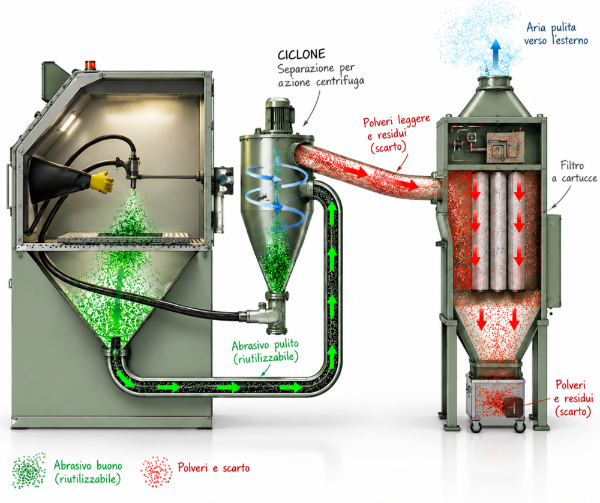
How are heavier burrs and impurities separated?
Why keep abrasive clean?
Does it improve finishing consistency?
When is a cyclone useful?
Is it necessary on every machine?
Can ferrous contaminants be separated?
When should magnetic grids be used?
Can a cyclone be added later?
How should it be selected?
FAQ – Frequently asked questions
🎯 Separates dust and unsuitable light particles; a sieve intercepts coarse residues.
🎯 It mainly improves process consistency by keeping recirculating media cleaner.
🎯 No. Assess process, media and production continuity.
🎯 Yes, on prepared Lampugnani machines after verifying extraction and recovery configuration.