
There is no single best sandblasting machine for every task. Choose according to component size and weight, abrasive, required finish and production quantity. Frequent media changes may favour direct recovery; consistent finishing may favour a cyclone; heavy parts need suitable handling; bulk small parts may suit automation. With direct abrasive recovery, media fall into the hopper and are drawn back into the gun. The shorter circuit simplifies emptying and media changes. Direct recovery allows quick emptying and changes, useful for workshops performing different processes throughout the day. Heavy or coarse media may be difficult to transport through compact Venturi cyclones and can accumulate in recovery ducts. Direct recovery avoids this transport stage, with gun, nozzle, extraction and settings correctly sized. An internal table lets the operator rotate a part without repeatedly lifting it. Assess handling as well as cabinet dimensions. A cyclone separates dust, residues and unsuitable material from reusable abrasive, helping produce a consistent and repeatable finish. Abrasive gradually fragments and mixes with removed residues. Separation stabilises the working mixture. Assess cyclone suitability for the process and media rather than adding one indiscriminately. Check useful cabinet dimensions, table diameter, load capacity and loading method. The part must be accessible as well as fit inside. Load the part outside the cabinet and move it inside on the trolley. This simplifies handling moulds and heavy mechanical parts; rotating the table provides access to different sides. Choose by mould size and weight. Lampugnani LC/1K TE supports up to 400 kg, while LC/2 TE and LC/3 TE support up to 600 kg. Match the configuration to the actual part and cycle. A rotating basket moves bulk parts while one or more guns progressively treat the surfaces. Assess basket capacity and speed, gun number and position, pressure and cycle duration for the required finish. Timers set and repeat blasting and subsequent blow-off times. Together with basket speed, pressure and gun position, they support repeatable production cycles. Manual blasting is versatile when component geometry changes. Automation suits repeated series with repeatable parameters. A manual cabinet with an automatic basket can combine individual and bulk processing. Venturi suction systems suit many cleaning, finishing and deburring tasks. Pressure systems use a pressurised vessel and generally provide greater abrasive delivery and impact energy. Ask how much removal capacity the process actually needs. Choose recovery, cyclone, cabinet dimensions, part handling, automation and blasting system together. Lampo-Lab tests compare media and settings on customer parts before defining the configuration. Which is the best sandblasting machine? Which suits frequent media changes? Which suits moulds and heavy parts? Which suits small parts?
How do you choose the right machine?
When are compact machines without a cyclone the best choice?
Which machine suits frequent abrasive changes?
Which machine suits coarse aluminium oxide and metallic grit?
When should you choose a rotating table?
When is a cyclone the best choice?
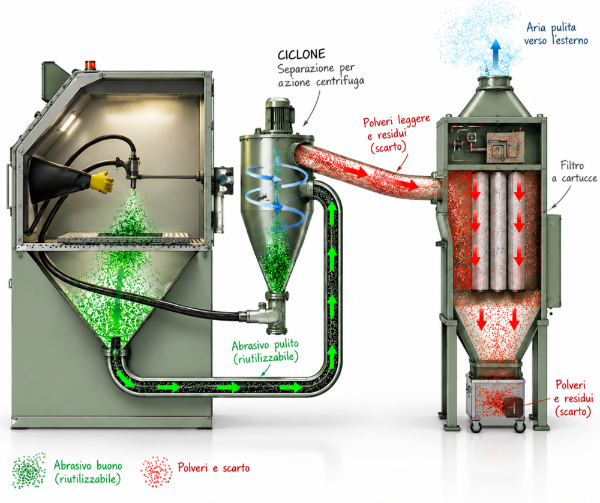
Why does a cyclone improve consistency?
Pull-out rotating tables for moulds and heavy parts
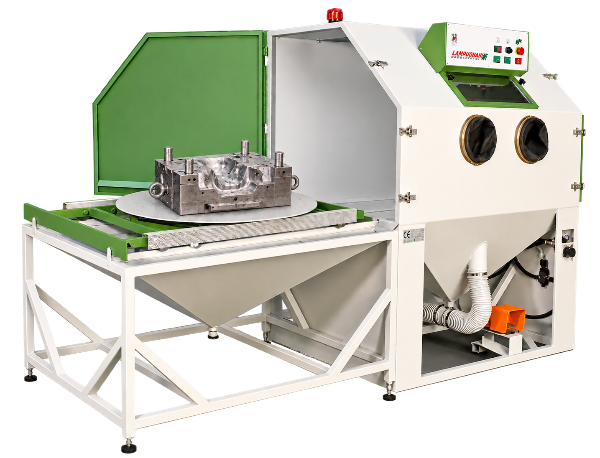
Why choose a pull-out table?
Which machine is best for moulds?
Automatic basket machines for small parts
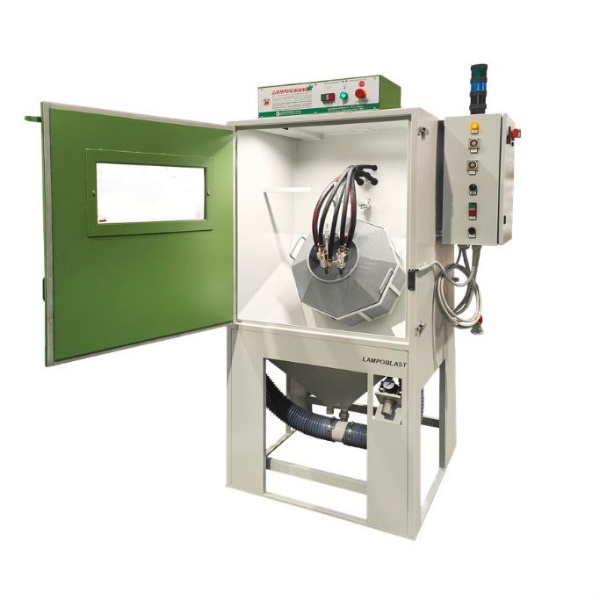
Which machine is best for bulk small parts?
Why are timers important?
Manual or automatic sandblasting?
Venturi or pressure: which is best?
Which is the best machine for your process?
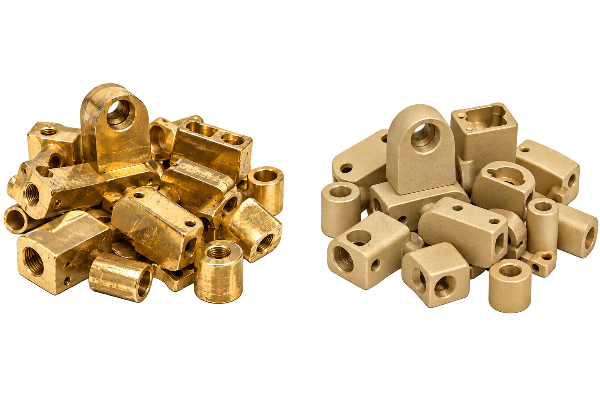
FAQ – Frequently asked questions
🎯 The best configuration depends on components, abrasive, finish and production cycle.
🎯 A direct-recovery machine without a cyclone simplifies emptying and changing media.
🎯 A correctly sized pull-out rotating table simplifies loading, unloading and handling.
🎯 An automatic rotating basket treats suitable parts in bulk with timed cycles and adjustable parameters.