
Both use compressed air but feed and accelerate abrasive differently. Choose according to the component, media, removal capacity, finish, processing time and available air. Compressed air passing through the gun creates suction and draws abrasive from the hopper through a separate hose. Air and abrasive mix in the gun and accelerate through the nozzle. There are two feeds: air and abrasive. Glass beads, ceramic beads, brown and white aluminium oxide and plastic media are used according to material and required result. It suits progressive treatment where high removal capacity is unnecessary: CNC and EDM parts, moulds, small parts, stainless steel satin finishing, cleaning and deburring. Adjust media, grain size, pressure and nozzle diameter. Abrasive is held in a pressurised vessel and pushed directly through the blasting hose to the nozzle with compressed air. It generally delivers more abrasive and greater impact energy. For high removal capacity or shorter processing times: oxides, mill scale, resistant paint and coatings, surface preparation and metal fabrication. Correctly size nozzle, pressure, airflow and recovery. Venturi draws abrasive into the gun by suction; pressure feeds it directly from the vessel. This changes abrasive delivery and energy transferred to the surface. Generally it provides higher removal capacity under comparable conditions. More power does not automatically improve satin finishing, light cleaning or delicate-part treatment. Media type and grain size, pressure, nozzle diameter, initial surface and component characteristics all matter. The same machine can produce different finishes by changing settings. Pressure systems, especially with large nozzles, may require substantial airflow. Check actual flow at working pressure and correctly size pipes, fittings and valves to limit pressure loss. Venturi suits versatile, controlled finishing and modest removal requirements. Pressure suits more intensive removal and higher productivity. Consider air availability as well as finish. At Lampo-Lab, compare systems, media and settings directly to verify finish and processing time rather than relying only on nominal specifications. What is the difference? Is pressure always better? Which media can be used? How should you choose?
What are the differences and which should you choose?
How does a Venturi sandblasting machine work?
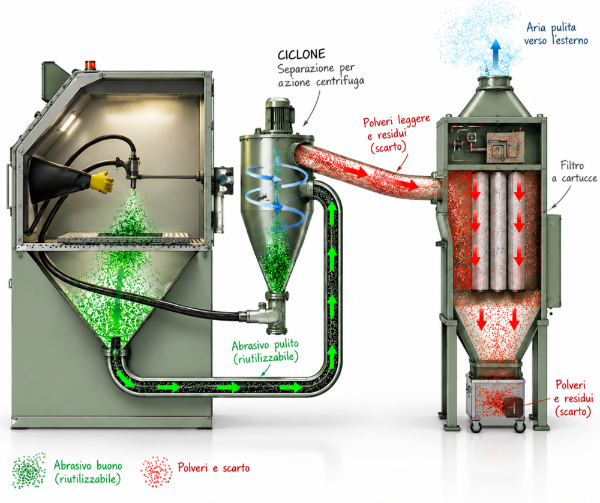
Which abrasives can a Venturi machine use?
When should you choose Venturi blasting?
How does a pressure sandblasting machine work?
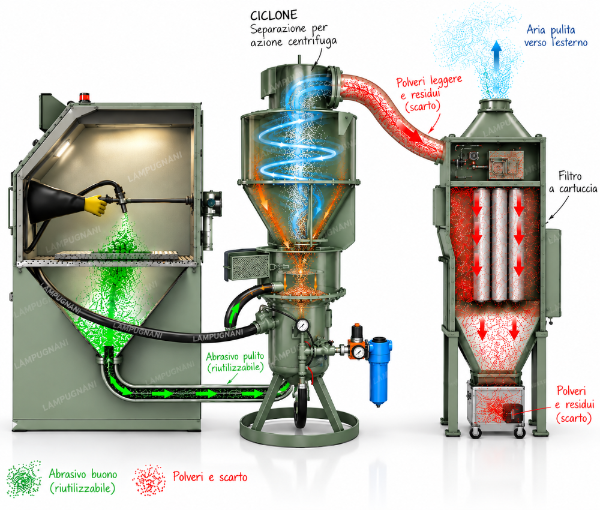
When should you choose pressure blasting?
What is the main difference?
Is pressure blasting more powerful?
What determines the final result?
How important is compressed-air consumption?
How do you choose between Venturi and pressure?
Why test both systems on the actual part?
FAQ – Frequently asked questions
🎯 Venturi uses suction; pressure pushes abrasive from a pressurised vessel.
🎯 No. Higher abrasive delivery and energy suit some removal tasks, while other processes need gentler control.
🎯 Glass and ceramic beads and different aluminium oxides can suit both systems, depending on grain size and machine configuration.
🎯 Compare the component, media, removal requirement, finish, processing time and available compressed air, ideally through trials.